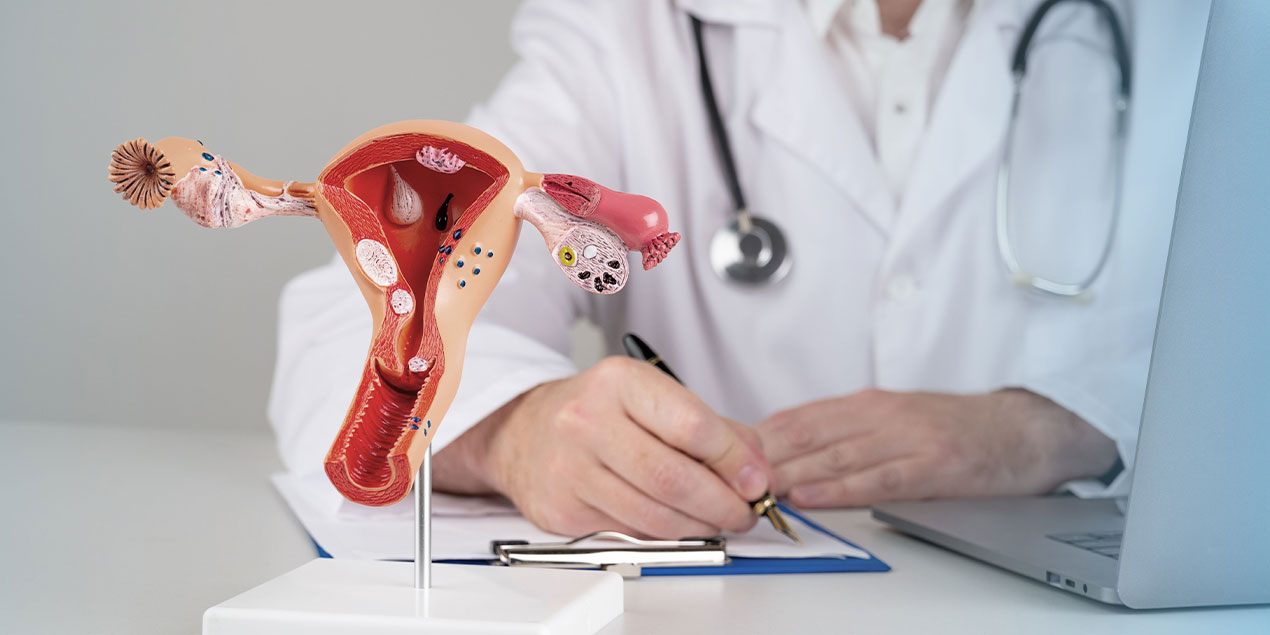
In couples presenting with the desire to have a child, we primarily investigate maternal factors through a gynecological examination, ultrasonography, and hormone tests. During these evaluations, problems that have never caused symptoms before may be revealed. These may include congenital uterine issues, uterine problems resulting from previous miscarriages or surgeries, swellings in the fallopian tubes known as hydrosalpinx due to obstructions, cysts related to endometriosis (chocolate cyst disease), or tubal blockages.
Congenital uterine anomalies may involve morphological or structural problems such as a uterine septum or a T-shaped uterus. These structural abnormalities generally lead to complications such as miscarriages, preterm labor, and occasionally delays in conception. Therefore, when these problems are detected or suspected, it is possible to examine the inside of the uterus via an endoscopic procedure and correct the issue simultaneously. This procedure is called hysteroscopy. Hysteroscopy is an outpatient surgical procedure; it does not require hospitalization, and discharge is planned for the same day. Depending on the specific uterine pathology, the procedure is typically completed within 15–30 minutes and is performed under anesthesia.
Uterine anomalies are highly variable. The most common issues include uterine septum, morphological deformities like a T-shaped uterus, intrauterine adhesions (Asherman’s Syndrome), and intrauterine myomas or polyps. A uterine septum may occasionally require more than one hysteroscopic procedure. Sometimes the septum has a broad base, making it impossible to eliminate entirely in a single session, or it may be necessary to re-examine the uterus via hysteroscopy 1–2 months later to check for any remnants or adhesions.
Similarly, myomas that exert pressure on the uterine cavity or fill the cavity can be removed hysteroscopically. However, if the myoma is large, multiple hysteroscopies may be required. Furthermore, because intrauterine adhesions can form after the removal of large myomas, a follow-up hysteroscopy 1–2 months post-procedure may be necessary.
On the other hand, since polyps have a soft consistency, a single hysteroscopy is usually sufficient for complete removal, regardless of their size.
Intrauterine adhesions are among the primary uterine problems that may require multiple hysteroscopies. While minor and localized adhesions can sometimes be opened in a single 5-minute session, widespread and dense adhesions within the uterus may require consecutive hysteroscopic procedures. Between these hysteroscopies, it is possible to objectively evaluate the uterine cavity by performing a medicated uterine X-ray (HSG).
The morphological deformity known as a T-shaped uterus, which has been frequently discussed recently, may also require uterine cavity expansion and, in some cases, multiple hysteroscopies. Evaluating the uterus with an HSG between hysteroscopies is the correct clinical approach for decision-making.
Ultrasonography and HSG are the most common methods used for the diagnosis of uterine problems. During ultrasonography, the thickness and appearance of the inner lining of the uterus (endometrium) on the 12th–14th days of the menstrual cycle provide vital information. Additionally, 3D ultrasonography allows for a clear visualization of the uterine cavity. It is advisable to perform at least one HSG to objectively identify intrauterine problems. Consequently, in cases where multiple hysteroscopies might be necessary, the frequent use of HSG and especially 3D ultrasonography can optimize planning and potentially reduce the number of required hysteroscopies.
With a similar rationale in laparoscopic surgery, if there are dense adhesions in the tubes, ovaries, or abdominal cavity, or if advanced stage endometriosis is present, multiple laparoscopies may be required. In cases where the pathology cannot be fully corrected, utilizing HSG for tubal-related issues or MRI for problems like advanced endometriosis during the interim periods is beneficial for reassessment.
Endoscopic procedures such as hysteroscopy and laparoscopy are successfully applied in gynecology. Occasionally, these procedures may need to be repeated. Through thorough and repeated evaluations of the patient before and between these endoscopic interventions, optimum results and pregnancy can be achieved.


