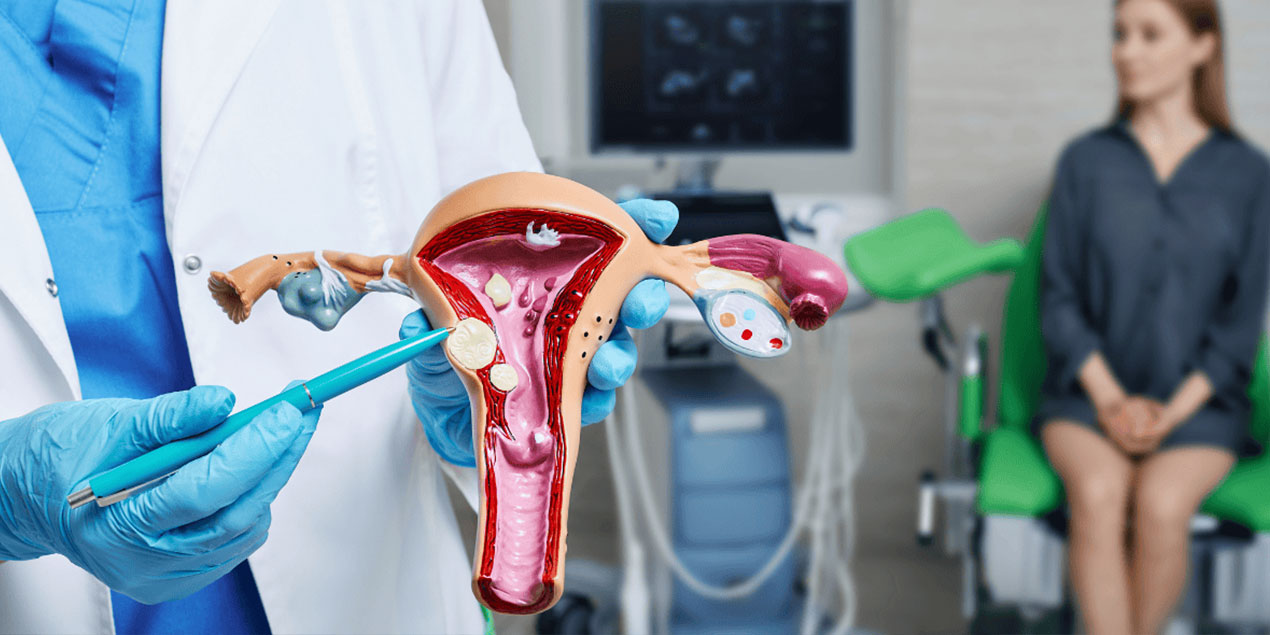
A myoma (fibroid) is a benign mass originating from the uterus. It causes symptoms depending on its location within the uterus. Myomas can be situated in three locations: protruding into the uterine cavity, within the uterine muscle, or growing toward the outside of the uterus. We know that myomas cause specific complaints based on where they are settled.
If a myoma grows toward the outside of the uterus and forms a mass, it is generally not a cause of complaint and is often detected incidentally during an examination. Occasionally, if it reaches very large dimensions, it can cause a palpable abdominal mass, gas, bloating, and abdominal pain. We sometimes see myomas reaching sizes that extend up to the navel. If they reach such large sizes, they must be surgically removed to prevent pressure on surrounding organs. Otherwise, if they are not very large, we generally do not operate on this type of myoma. We monitor their growth through examinations conducted at 6-month intervals.
If the myoma is located within the uterine muscle (intramural), it may cause symptoms and require surgery depending on its size and number. Myomas of this type that reach very large dimensions must also be removed surgically. Myomas located in the uterine muscle can occasionally lead to infertility. Specifically, myomas larger than 4-5 cm or those present in high numbers can obstruct the uterine cavity and prevent a pregnancy from progressing healthily. To understand and demonstrate the relationship between these myomas and the uterine cavity, imaging methods such as 3D ultrasonography, medicated uterine X-ray (HSG), or MRI should be utilized. When such myomas are large or numerous, they can lead to complaints such as pain, intermenstrual spotting, excessive menstrual bleeding, prolonged menstruation, and anemia. Although there is information suggesting these myomas may cause infertility, we cannot definitively say they cause infertility or pregnancy loss in every case. The crucial factor here is the relationship between these myomas and the uterine cavity. When we detect such myomas, we must establish this relationship.
If a myoma grows toward the uterine cavity, these myomas cause infertility and recurrent miscarriages. This is because the uterine cavity is the area where the embryo attaches, settles, and grows; any structure that narrows this space threatens the formation and continuation of pregnancy. These types of myomas, which project into the uterus, also disrupt the integrity of the uterine lining, known as the endometrium. Consequently, they can cause bleeding irregularities—such as intermenstrual spotting, excessive and prolonged menstrual bleeding, or periods that start and end with brown spotting—and occasionally menstrual cramps. The type of myoma that causes failure to conceive or leads to miscarriage is the one that grows into or protrudes toward the uterine cavity, referred to as a submucosal myoma.
We diagnose myomas using imaging methods such as ultrasonography, 3D ultrasonography, HSG, and MRI. Myomas that form a mass in the abdomen can also be identified manually during a gynecological examination. When we detect a myoma, if there is a desire for pregnancy, the relationship of the myoma with the uterine cavity, the number of myomas, and their sizes are our criteria for deciding on surgery.
Generally, we remove submucosal myomas (those growing toward the uterine cavity) via hysteroscopy. If the size is large, it may sometimes be necessary to perform hysteroscopy more than once. Since adhesions may form inside the uterus after large myomas are removed, it may be necessary to re-examine the inside of the uterus with office hysteroscopy 1.5-2 months later. If adhesions have formed, they are opened at the same time. There is generally no harm in conceiving immediately after a myoma is removed via hysteroscopy. Therefore, follow-up or treatment for pregnancy can begin 2 months later.
When myomas growing within the uterine muscle exceed 4-5 cm, are numerous, or narrow the uterine cavity, they should be removed laparoscopically. After removing myomas via laparoscopy, it is necessary to use contraception for 4 months; otherwise, a resulting pregnancy could cause the sutures where the myoma was removed to tear or open. Spontaneous pregnancy is permitted 4 months after the myoma is removed via laparoscopy.
In summary, a myoma is not actually a direct cause of infertility on its own. However, the critical factor is the endometrial cavity (the internal space of the uterus). Myomas that exert pressure on this area or disrupt its integrity should be removed via hysteroscopy or laparoscopy depending on their location. A myoma is a pathology that can cause infertility or recurrent miscarriages depending on its position in the uterus, its size, and its quantity.


