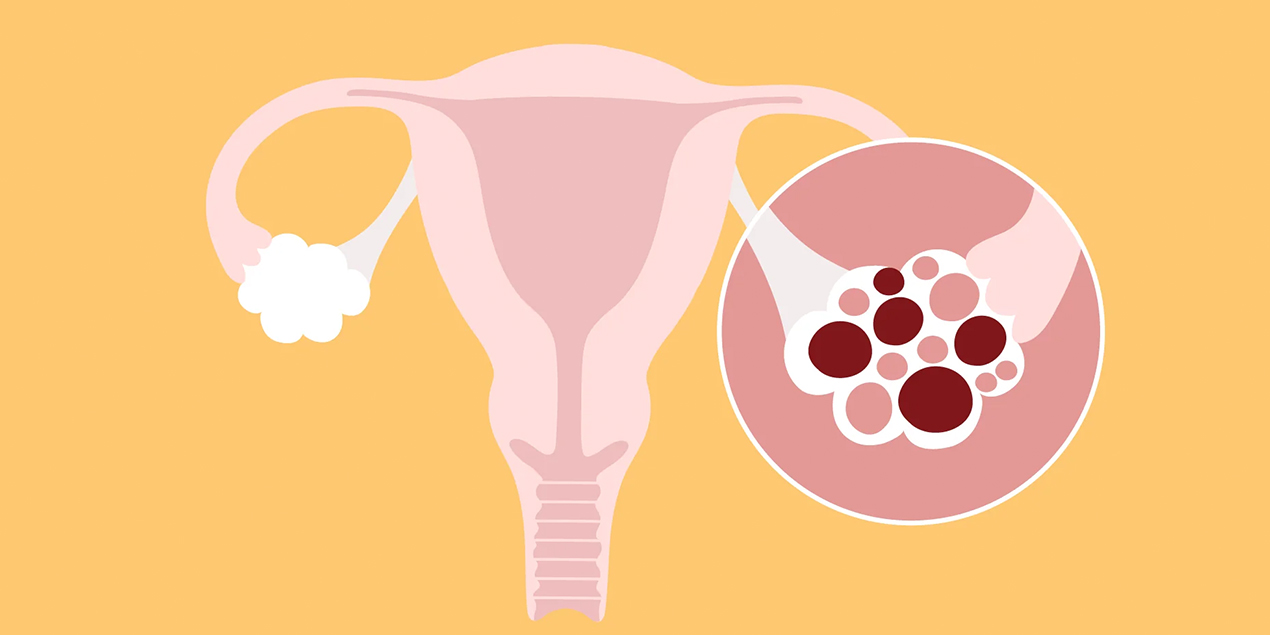
Polycystic ovary syndrome can be a cause of infertility. Infertility is one of the most common conditions seen in women with polycystic ovary syndrome (PCOS). Menstrual irregularity, hirsutism (excessive hair growth), acne, excess weight, and infertility are the most common complaints it causes. This condition is seen in nearly one-fifth of women who wish to have children.
How Does Polycystic Ovary Syndrome Cause Infertility?
The reason PCOS causes infertility is that although ultrasonography shows these patients have a large number of eggs, one of these eggs cannot mature and ovulate regularly every month. Since one egg cannot spontaneously grow ahead of the others, ovulation does not occur at the expected time, which consequently delays menstruation. Sometimes delayed ovulation can occur, meaning one of the eggs matures and ovulates late; in such cases, the PCOS patient menstruates spontaneously after 1.5-2 months. However, if egg development does not occur spontaneously, they cannot menstruate without medication.
When regular egg development and ovulation do not occur every month, spontaneous pregnancy cannot take place. Sometimes, PCOS patients who have infertility issues may have regular periods, but due to excess weight, insulin resistance is observed, and egg quality may be lower as a result. In PCOS patients, egg quality and—when IVF is performed—embryo quality can be low; sometimes recurrent miscarriages are also seen. The reason for this is generally stated to be hormonal and metabolic factors.
What Are the Symptoms of Infertility in Polycystic Ovary Syndrome?
Infertility issues are frequently seen in PCOS patients who are overweight, do not menstruate without medication, and have severe hirsutism. This is due to both the lack of or rarity of egg development and the lower quality of eggs and embryos developed due to metabolic reasons. Additionally, if metabolic issues are present, the embryo may fail to implant in the uterus.
In patients where PCOS causes infertility, the chance of pregnancy decreases due to the ovulation problem. For example, while a PCOS patient who menstruates every two months has six chances to conceive within a year, a woman who menstruates every month has 12 chances a year. Therefore, the chance of spontaneous pregnancy for a PCOS patient is lower than that of a woman who menstruates every month.
How Is Infertility Diagnosed in Polycystic Ovary Syndrome Patients?
Two possibilities come to mind for women who have irregular periods and cannot conceive: infertility due to polycystic ovary syndrome or an early decrease in ovarian reserve. We can usually distinguish between these two using ultrasonography and certain blood tests. Therefore, it is appropriate for every young girl and woman with menstrual irregularity to discuss this with a gynecologist to clarify the situation.
The menstrual irregularity seen in PCOS patients is the fundamental cause of infertility in these women. In women whose periods occur at intervals longer than 35-40 days and who have excess weight or hair growth issues, the appearance of the ovaries is examined via gynecological examination and ultrasonography. When we see more than 10 follicles, 2-10 mm in size, arranged like a necklace, and if the ovarian volume is higher than normal, we speak of a polycystic ovary appearance. If accompanied by menstrual irregularity, these women should be informed and investigated for infertility. In PCOS patients, revealing insulin resistance through blood tests is beneficial for both regulating periods and preventing the future development of diabetes.
How Is Infertility Treated in Polycystic Ovary Syndrome Patients?
PCOS patients may come to us with complaints such as “my ovaries aren’t working” or “the egg membrane is too thick to crack.” Therefore, stimulating the ovaries and subsequently administering a trigger shot is the first-step method to achieve pregnancy. If pregnancy is not achieved with 3-6 months of monitoring in this way, the next step, vaccination (IUI), can be initiated. If pregnancy is still not achieved after 2-3 IUI attempts, it is beneficial to proceed to IVF treatment. Patience is necessary during this process. Should we perform ovulation tracking in PCOS patients whose partners have slightly low sperm values or if one of their tubes is blocked? It is more accurate to decide on the answer to this question by discussing it with our patient and her spouse. It is clear that the success rate will be lower in such cases.
How Is Ovulation Tracking Performed in Polycystic Ovary Syndrome Patients?
On the 2nd or 3rd day of the period, the ovaries are examined via ultrasound and medications are started. A follow-up ultrasound is performed 5-7 days later. If there is egg growth in response to the medications, a trigger shot is administered within a week and intercourse is recommended. For ovulation tracking or IUI, visiting the physician 2 or 3 times a month is sufficient.
In PCOS patients with infertility issues, if there is excess weight, we should recommend regulating the nutrition plan and performing regular exercise. Following such planning, treatment can be applied with medications that increase insulin hormone sensitivity. Leading these medications are those containing metformin. The use of these medications during ovulation tracking can be recommended.
If the tubes of PCOS patients are open and there is no sperm problem, ovulation tracking or IUI methods may be sufficient to achieve pregnancy. However, if the duration of marriage has exceeded 5 years, it would be more appropriate to switch to IVF treatment instead of these treatments, as impatience in couples can negatively affect the marriage. If there is an accompanying sperm problem or tubal blockage, IVF treatment is initiated directly.
The chance of pregnancy with ovulation tracking in polycystic ovary patients can be expressed as an average of 20-25% per month. Furthermore, IUI success can be stated as 30% at best. With IVF treatment, the success rate in these patients will be a minimum of 40-60%.
What Should Be Considered for Success in Infertility Treatments for Polycystic Ovary Patients?
Proceeding to IVF treatment after weight loss increases treatment success. Excess weight negatively affects treatments and leads to the use of more medication. Sometimes insulin resistance can also be present in PCOS patients, making it difficult to lose weight. In this case, the way to break this vicious cycle is through exercise. With a diet low in carbohydrates and high in fiber combined with exercise, periods may even regulate spontaneously without medication. Additionally, smoking should not be used, as egg quality can be negatively affected.
During the IVF treatments of PCOS patients, the problem of ovarian hyperstimulation syndrome (OHSS) may arise. To prevent this, using low-dose injections and close monitoring are important. If overstimulation occurs, the embryos formed during treatment can be frozen without being transferred to the uterus and transferred 1.5-2 months later. When this path is followed, it ensures the healthy progression of the pregnancy and prevents problems for the mother.
What Are the Infertility Treatment Methods in Polycystic Ovary Syndrome Patients?
Our first recommendation for infertile PCOS patients is to achieve weight loss and exercise. A diet low in carbohydrates and high in fiber combined with exercise can regulate periods spontaneously and allow for spontaneous pregnancies to occur.
In PCOS patients where we detect insulin resistance, periods may regulate with medications containing metformin. It is necessary to use these medications for at least 6 months. Additionally, these women may have high TSH (thyroid hormone) or prolactin (milk hormone) levels; when we correct these with medication, spontaneous pregnancies can occur.
In women with PCOS who want a child, we must first address any problems found during the gynecological examination and ultrasonography. For example, if there is a polyp in the uterus, it should be removed using an endoscopic method called hysteroscopy. It would be appropriate to reveal hormonal problems with blood tests and perform a glucose tolerance test if there is a family history of diabetes. During this period, a semen analysis is necessary to understand if there is a sperm problem in the partner. Subsequently, a uterine film (HSG) is recommended to reveal if there is a blockage in the woman’s tubes.
After this basic evaluation, infertility causes other than PCOS will be revealed. When a problem is detected, it must first be corrected. Furthermore, if there is smoking in both the man and the woman, it is recommended to stop. Smoking negatively affects egg and sperm quality.
If there is no problem in the sperm analysis and the tubes are open, the first step of treatment for PCOS patients to have children is the recommendation of ovulation tracking and timed intercourse. Since there is an ovulation problem in PCOS patients, egg development is stimulated in a controlled manner with pills or injections during ovulation tracking. After this process, which starts with the period and lasts 10-15 days in total, intercourse is recommended. Tracking in this manner can be maintained for 3-6 months. If pregnancy does not occur or if negative psychological feelings are intense for the woman, IUI can be initiated as the next stage.
IUI treatment in PCOS patients also starts with the period and lasts two weeks. During this process, egg development is again ensured with injections, and when the mature egg develops, the sperm taken from the spouse is prepared in the laboratory and placed into the uterus. IUI treatment can be applied 2-3 times in this way.
If results are not obtained with IUI or if the duration of marriage is longer than 5 years, it is recommended to switch to IVF treatment. The egg development stage is very important in the IVF treatment of PCOS patients; overstimulation may occur, leading to the development of OHSS, which can cause fluid accumulation in the abdomen, shortness of breath, and respiratory distress, necessitating hospitalization. It is best for the IVF treatments of these patients to be closely monitored and followed by an experienced physician.
PCOS patients are a group where we achieve high pregnancy rates. When we look at the total, our chance of achieving pregnancy with treatments reaches 80% in these patients. Losing weight before becoming pregnant in PCOS patients will ensure that the resulting pregnancies continue healthily and prevent problems such as high blood pressure and gestational diabetes.
Which Medications Are Used in Infertility Treatment for Polycystic Ovary Syndrome Patients?
When there is an infertility problem in polycystic ovary patients, medications containing metformin can be used to ensure the regularity of periods. These medications can regulate periods by increasing insulin sensitivity and providing weight loss, allowing for spontaneous pregnancies to occur.
In the ovulation tracking of polycystic ovary patients, pills containing clomiphene citrate or letrozole can be used. These medications can stimulate egg development in a controlled manner. When using these pills, doses should be carefully monitored and overstimulation should not be allowed. Ovulation tracking in PCOS patients should be done with close monitoring and meticulous care.
If follicle/egg development does not occur with clomiphene citrate or letrozole, egg development in PCOS patients is stimulated with low-dose injections called gonadotropins. The use of these injections should be managed by experienced physicians. If excessive doses are used or if dose adjustment is not done meticulously, the OHSS condition can develop, leading to health problems. These injections contain FSH or HMG and are easy to use, as they can be administered like insulin injections through the navel.
After egg development is ensured in PCOS patients, a trigger shot containing HCG is administered to support or stimulate the ovulation of the egg.


