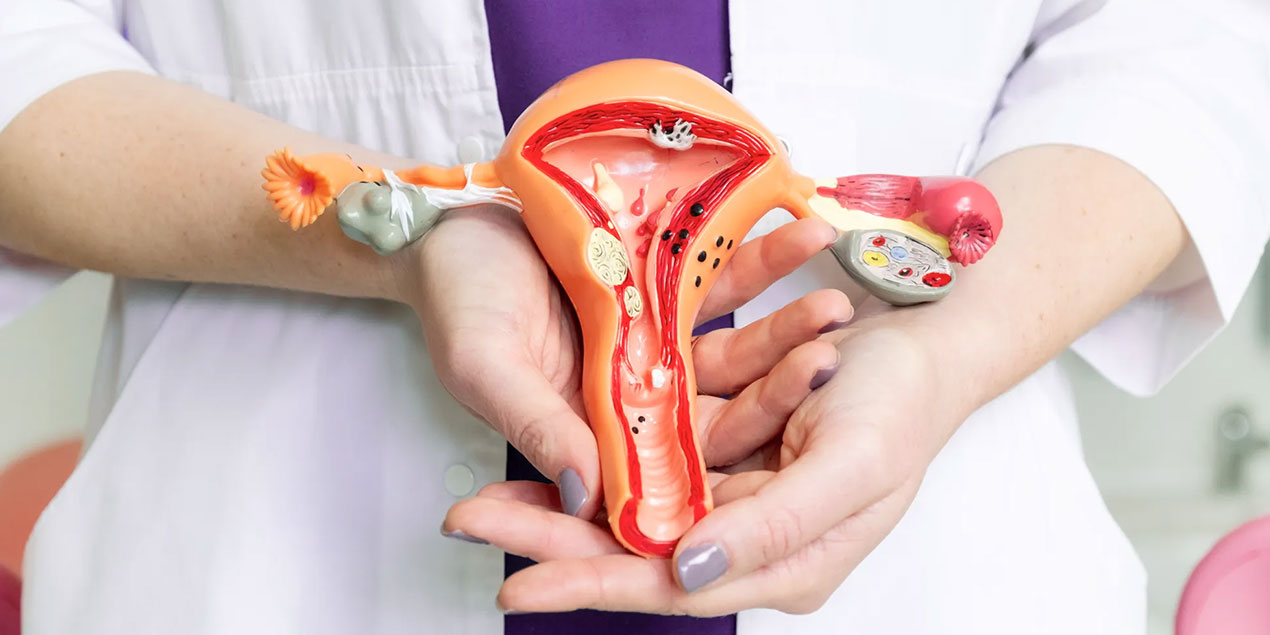
Endometriosis, or chocolate cyst disease, is an estrogen-dependent disease that has been encountered more frequently in recent years. It can affect the quality of life due to the pain it causes in women and is a benign condition that requires long-term treatment. It is stated to be more common in developed countries and among educated groups. Today, there are support groups and associations worldwide regarding endometriosis, and scientific meetings specifically focused on endometriosis are organized. In the future, many current unknowns about endometriosis will come to light, and the disease will be fully treatable.
What is Chocolate Cyst Disease?
Endometriosis, in other words, chocolate cyst disease, is a condition where cells similar to those in the endometrium (the layer lining the inner surface of the uterus) are found in other organs of a woman. Endometriosis cells can grow and bleed in the organs where they are located, creating masses, adhesions, and narrowings, thus leading to complaints.
Every month, hormones secreted in the female body cause growth and thickening in the endometrium layer to allow a fertilized egg to implant. If pregnancy does not occur, this thickened endometrium layer is shed and bleeds, resulting in menstruation. Endometriosis cells located in other organs give the same response to the hormones secreted in the body; these cells grow just like the endometrial cells in the inner wall of the uterus, and they shed and bleed during menstruation. Since this bleeding inside the abdomen or other organs cannot leave the body, it causes abdominal pain, tenderness, adhesions, and over time, masses. For example, when endometriosis cells are located on the ovary, an ovarian cyst can form over time due to the growth and bleeding of the cells; this cyst is called a chocolate cyst (endometrioma) because its content is dark reddish-brown.
- Endometriosis is a benign but chronic disease that requires long-term treatment.
- Endometriosis is a treatable disease.
- Endometriosis is not cancer.
- Endometriosis is not contagious.
In Which Organs is Endometriosis Chocolate Cyst Disease Seen?
Endometriosis Chocolate Cyst Disease is generally found within the pelvis; around the ovaries, on the tubes, on the surface of the uterus, on the ligaments that hold the uterus in place, and on the surface of the peritoneum (abdominal lining). Additionally, it can more rarely be found in the intestines and the urinary bladder. In rare cases, endometriosis has been encountered in the skin, spinal cord, lungs, eyes, and brain. The only organ where endometriosis has not been encountered is the spleen.
Why Does Endometriosis Chocolate Cyst Disease Occur?
Exactly how and why endometriosis forms is not clearly known. Various theories have been proposed. It has been suggested that not a single theory, but multiple theories may be involved in the formation of endometriosis. The theories are as follows:
Retrograde Menstruation
In this theory, during menstruation, endometrial cells flow backward through the tubes and spill into the abdominal cavity. The spilled cells attach to the organs inside the abdomen and grow. Most women experience retrograde menstruation, but their bodies prevent these cells from settling on organs by clearing the blood containing these cells. Therefore, it has been suggested that women with endometriosis Chocolate Cyst Disease may have certain immune system problems, and for this reason, endometriosis cells cannot be cleared from the abdomen.
Spread via the Circulatory or Lymphatic System
This is a theory based on endometriosis cells entering the blood circulation or lymphatic circulation and spreading throughout the body. This theory can explain the development of endometriosis in distant organs such as the eyes and skin.
Genetic Predisposition
The fact that endometriosis is seen in almost all female members of some families suggests the possibility of a genetic predisposition.
Disorder in the Immune System
In this theory, the body’s immune system cells cannot fight the endometriosis cells. The coexistence of some other immune system diseases in most women with endometriosis suggests this possibility.
Environmental Factors, Exposure to Chemical Substances
Certain toxins in our environment (such as dioxin) can cause endometriosis by affecting the immune system and the reproductive system.
Metaplasia
Metaplasia is the differentiation of one cell type into another. Metaplasia is generally the change of cells to adapt to a new environment in response to a stimulus.
What are the Symptoms of Endometriosis Chocolate Cyst Disease?
Classic Symptoms
- Painful menstruation (dysmenorrhea)
- Pain during sexual intercourse (dyspareunia)
- Infertility
Other Symptoms
Pain
- Excessive pain during the menstrual period
- Pain before the menstrual period begins
- Pain during or after sexual intercourse
- Pain during the ovulation period
- Pain during examination
- Leg pain
- Low back pain
- Constant pelvic pain
Bleeding
- Bleeding with clots during the menstrual period
- Prolonged menstruation
- Pre-menstrual spotting
- Irregular menstruation
Symptoms Related to the Bowels and Bladder
- Pain during defecation
- Bleeding from the intestines
- Pain while urinating
- Blood in the urine
- Diarrhea, constipation
- Colic pain
Other Symptoms
- Numbness
- Nausea
- Excessive fatigue
- Depression
- Feeling of faintness or fainting during the menstrual period
Most women with endometriosis experience some of these symptoms, while some may have no complaints at all. The size and prevalence of endometriosis in the body are not directly proportional to the pain felt. Chocolate cysts on the ovary can be painless and may only be found by chance during an infertility investigation. A small-sized endometriosis lesion can be more painful than a more widespread and larger endometriosis lesion.
The cause of all these symptoms can be endometriosis, but it could also be other diseases. Therefore, women with such complaints should consult a gynecologist and be evaluated for the presence of endometriosis Chocolate Cyst Disease.
How Common is Endometriosis Chocolate Cyst Disease?
Endometriosis Chocolate Cyst Disease is seen in roughly one in every 10 women. Endometriosis is seen in 6 out of every 10 women with menstrual pain, and in 4 out of every 10 infertile women who want to have children. Among adolescent girls who have pelvic pain and menstrual pain that do not respond to painkillers, 50% may have endometriosis.
What are the Risk Factors for Endometriosis?
It is known to be more common in white, tall, thin, and red-haired women. It is most frequently seen in the Asian race. Girls whose families have a history of endometriosis Chocolate Cyst Disease are in the risk group. On the other hand, it is seen more frequently in women who have frequent periods, long menstrual bleeding, no children, consume a diet poor in fiber and high in fat, have high alcohol consumption, do not exercise, and consume heavy caffeine.
Who Gets Endometriosis Chocolate Cyst Disease?
Although it is more often a disease of the reproductive age, endometriosis can occur in adolescence, in single young women, and even in postmenopausal women. Endometriosis is frequently seen in infertile women and in women with congenital obstructive uterine abnormalities.
Is Age Important in the Emergence of Endometriosis Chocolate Cyst Disease?
Endometriosis Chocolate Cyst Disease generally affects women in their reproductive years; we can say it is an estrogen-dependent disease. It is most commonly seen in the 30s. Although it can be seen in adolescence and menopause, it is rare at these ages.
How is Endometriosis Chocolate Cyst Disease Diagnosed?
In the diagnosis of endometriosis, the evaluation of complaints and auxiliary imaging methods such as gynecological examination and ultrasonography are important for making a diagnosis. Suspecting the disease is crucial for diagnosing endometriosis Chocolate Cyst Disease. The possibility of endometriosis should be kept in mind for women and young girls with pelvic pain. Radiological examinations, blood tests, and physical examination are not definitive methods for diagnosis. A normal result on these tests does not indicate the absence of endometriosis. This is because endometriosis Chocolate Cyst Disease may have only affected the peritoneum or may have caused serious adhesions between the uterus and the ovaries, but such lesions cannot be revealed by imaging methods. Therefore, a delay in diagnosis can be experienced. According to recent studies, 7-12 years pass between the onset of symptoms and the diagnosis. The definitive diagnosis of endometriosis is made with an endoscopic examination called laparoscopy. Laparoscopy surgery is an endoscopic operation where the abdominal cavity, the outer surface of the uterus, and the ovaries can be examined by entering the abdomen with a camera through a small incision made in the navel. In this way, the doctor detects pelvic organs, ovarian cysts, and endometriosis foci. It is also possible to treat these endometriosis foci laparoscopically at the same time.
When Should an Endometriosis Patient Consult a Physician?
Endometriosis should come to mind for women and young girls whose periods are painful, do not respond to painkillers, or who cannot go to work due to pain during their periods and whose social lives are restricted. Similarly, endometriosis Chocolate Cyst Disease should be considered for women who have pain during intercourse and problems with being unable to conceive. In summary, women and young girls with one or more problems such as severe menstrual cramps, pain during intercourse, infertility, and menstrual irregularity should definitely consult a physician without delay. Especially in young girls, severe menstrual cramps should not be accepted as normal; a physician should be consulted to investigate whether the cause is endometriosis, thus preventing a delay in diagnosis.
Are There Errors Patients Make Due to Misinformation Regarding Endometriosis?
Since menstrual cramps in young girls or women are accepted as a normal situation, they do not visit a physician with this complaint. This leads to delays in the diagnosis of endometriosis. Especially young girls or unmarried women hesitate to go to a gynecologist. The non-use of prescribed hormonal drugs or birth control pills due to the fear that they cause infertility can cause endometriosis Chocolate Cyst Disease to progress while it could otherwise be kept under control. Therefore, if there are severe menstrual cramps, a physician must be consulted, and if endometriosis is detected, the prescribed medications should be used regularly. By acting in this way, it is possible to keep the endometriosis disease under control.
What is the Relationship Between Infertility and Endometriosis?
Endometriosis is among the leading causes of infertility. Especially in infertile couples where there is no problem with the male, endometriosis is encountered at a rate of 40%. Endometriosis causes infertility through different mechanisms. By causing intra-abdominal adhesions, it can lead to tubal blockages and disruption of the relationship between the tubes and the ovaries. Endometriosis can cause a decrease in ovarian capacity or a decrease in egg quality by forming cysts in the ovary. It has also been suggested that in endometriosis, there may be a problem with the uterus’s ability to hold the embryo. This situation is more likely to occur in patients with adenomyosis, known as endometriosis within the uterine muscle. Therefore, infertility is not seen in every endometriosis patient, but infertility problems are observed in 30% of women with endometriosis.
Can Women with Endometriosis Have Children? Is it Possible to Give a Figure? It is Estimated That 30% of Women May Not Be Able to Have Children
Endometriosis has been detected in 40% of infertile women. Not all endometriosis patients experience infertility; there are infertility problems at a rate of 30%. Occasionally, women with large chocolate cysts in the ovary can conceive even spontaneously. At this point, whether the disease causes a blockage in the tubes is important. In a woman with endometriosis, if she has no child, the tubes must be evaluated, and it should be revealed whether there is a blockage. Additionally, ovarian capacity in these women should be evaluated with ultrasonography and blood tests such as AMH; if the ovarian reserve is limited, one should not be late in trying to have children.
Does Endometriosis Disappear After Menopause?
Since the estrogen hormone decreases in the body with menopause, endometriosis lesions also regress and shrink. However, if an endometrioma (chocolate cyst) has been detected in a postmenopausal woman and there are pelvic or abdominal pains, surgical treatment should be pursued; ultimately, it may be necessary to remove the uterus and ovaries. In endometriosis patients in menopause who have previously undergone surgery, some medications can also be used if pain occurs. In conclusion, although endometriosis lesions frequently regress after menopause, surgical treatment should be preferred when there is a complaint of pain.
How is Endometriosis Chocolate Disease Treated?
Endometriosis can be treated medically (with medication) and surgically (with surgery). If a woman with endometriosis wants a child, medical treatment is not performed; surgical treatment is only performed if there is a large chocolate cyst or a problem in the tubes. In these women, follow-ups are initiated to have children as soon as possible, mostly through assisted reproductive treatments. If the main complaint in a woman with endometriosis is pain—that is, if treatment is to be performed for pain—medical treatment is performed first. The complaint of pain may be relieved with certain hormonal medications. Additionally, hormonal intrauterine devices (IUDs), hormonal pills, and injections can be used in treatment. When these drugs are used in a controlled manner, no serious problems are encountered with long-term use, but they should be recommended for use under doctor supervision. If the pain is not relieved with medication, or if there is endometriosis that leads to serious anatomical problems, called deep endometriosis, surgical treatment should be preferred. In surgical treatment, adhesions are opened, endometriosis foci are cleaned, chocolate cysts in the ovary are removed if present, and if narrowings have formed in the surrounding intra-abdominal organs due to endometriosis (in the intestines or urinary tracts), the affected area is removed and the narrowings are corrected.
Does Endometriosis Create a Risk for Different Health Problems?
Endometriosis and autoimmune diseases are frequently seen together. Rheumatological diseases and conditions like fibromyalgia can also coexist. Allergic disorders may also be seen together. We see these diseases together with endometriosis probably because they emerge as a result of immune system problems. On the other hand, studies regarding the risk of ovarian cancer in women with endometriosis have shown that certain types of ovarian cancer are seen more frequently in women with endometriosis.


