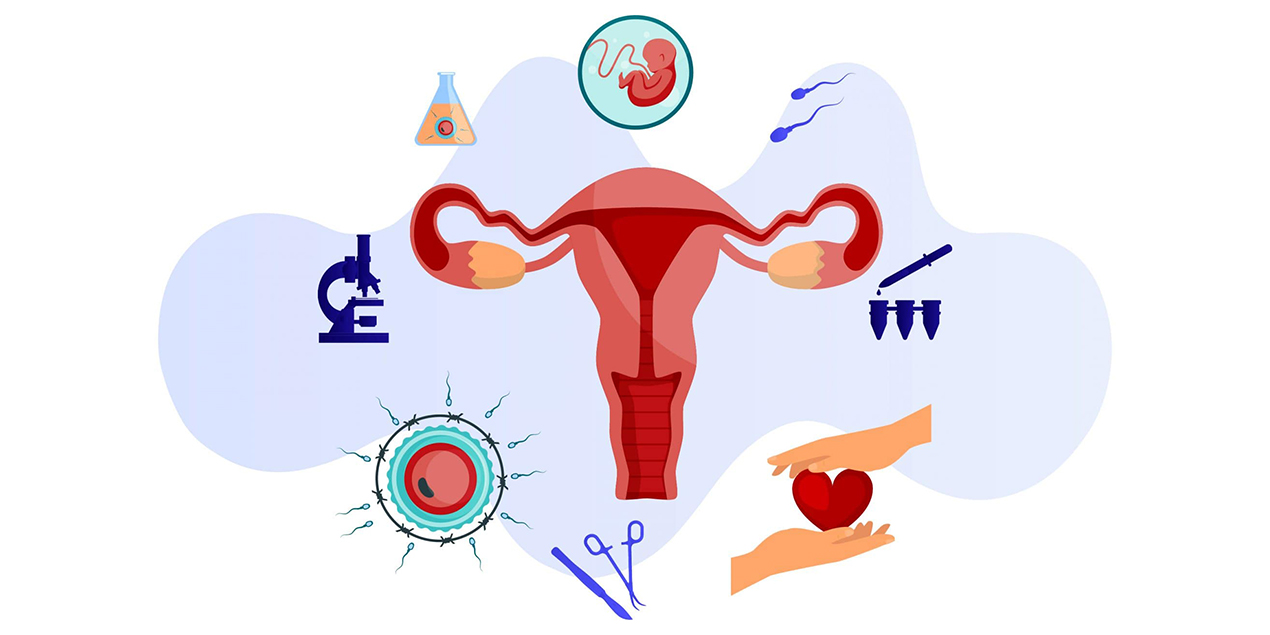
Polycystic ovary syndrome is a disease characterized by menstrual irregularity, excess weight, and occasionally increased hair growth (hirsutism). Polycystic ovary disease is the first thing that comes to mind in all young girls and women with delayed periods. Especially in young girls or women who are slightly overweight and whose periods occur every 2-3 months or who do not menstruate without medication, polycystic ovary disease is observed.
Polycystic ovary disease can coexist with excess weight, and insulin resistance may also accompany it. In those with insulin resistance, the risk of diabetes, obesity, or cardiovascular disease increases in the future. Breaking insulin resistance in polycystic ovary patients will reduce these risks. Certain medications can be used to break insulin resistance, but what is essentially important is exercise and ensuring weight control. It is possible to overcome insulin resistance only with weight loss and exercise.
In polycystic ovary disease, complaints of menstrual irregularity, hair growth, acne, and infertility can occur. A woman with menstrual irregularity, hair growth, and excess weight who cannot conceive spontaneously may have polycystic ovary syndrome. The reason for the inability to conceive in these women is irregular ovulation.
In the examinations of polycystic ovary patients, although numerous eggs are seen on ultrasonography, the eggs cannot mature and rupture. Since one of the eggs cannot grow spontaneously by getting ahead of the others, no rupture occurs at the time of ovulation; therefore, menstruation is delayed. Sometimes late ovulation can occur, meaning one of the eggs can grow and rupture even if delayed; in this case, menstruation occurs spontaneously after 1.5-2 months. However, in a polycystic ovary patient who does not menstruate without medication, since there is no growth and rupture in the eggs even if delayed, menstruation does not come spontaneously, and menstruation is not seen without medication.
The chance of pregnancy also decreases due to this ovulation problem in polycystic ovary patients. For example, while a polycystic ovary patient who menstruates every two months has a chance to get pregnant six times a year, a woman who menstruates every month has a chance to get pregnant 12 times a year. Therefore, the chance of a polycystic ovary patient conceiving spontaneously is lower than that of a woman who menstruates every month.
For all these reasons, performing ovulation tracking in a polycystic ovary patient who has no sperm problems and whose tubes are open, and using some ovulation-stimulating drugs or injections during this process, will increase the chance of pregnancy. When regular egg development is achieved with these drugs and intercourse is recommended after an ovulation trigger shot is administered, the probability of conceiving increases. In these patients, it may be beneficial to give the trigger shot as a precaution against the risk of the egg not rupturing spontaneously.
Polycystic ovary patients may come to us with statements like “my ovaries are not working” or “the egg membrane is thick and not rupturing.” Therefore, stimulating the ovaries and then giving an ovulation trigger shot is the first-step method for achieving pregnancy in these patients. If pregnancy is not achieved with 3-6 months of follow-up in this way, the next step, vaccination (insemination), can be started. Again, when pregnancy is not achieved despite 2-3 insemination attempts, it is beneficial to switch to IVF treatment. One must be patient during this process. So, should we also perform ovulation tracking in polycystic ovary patients whose sperm values are slightly low or one of whose tubes is blocked? It would be more accurate to decide on the answer to this question after talking with our patient and her spouse. It is clear that success will be lower in such cases.
The chance of pregnancy with ovulation tracking in polycystic ovary patients can be expressed as an average of 20-25% each month. Similarly, the success of insemination can be stated as 30% at best. With IVF treatment, the success rate in these patients will be a minimum of 40-60%.
So, how is ovulation tracking performed in polycystic ovary patients? The ovaries are examined via ultrasonography on the 2nd or 3rd day of the period and medications are started. Follow-up ultrasonography is performed 5-7 days later, and if there is egg growth in response to the medications, an ovulation trigger shot is administered within 1 week and intercourse is recommended. For ovulation tracking or insemination, it is sufficient to visit the physician 2 or 3 times a month.
Two possibilities come to mind in women who have irregular periods and cannot conceive: Polycystic ovary disease and early decrease in ovarian reserve. We can usually differentiate between the two with ultrasonography and certain blood tests. Therefore, it would be appropriate for every young girl and woman with menstrual irregularity to talk to a gynecologist and clarify the situation. The follow-up and treatment of these two diseases are different. In a polycystic ovary patient who wants to get pregnant and has irregular periods, ovulation tracking can be performed; there is no need to switch to insemination or IVF treatment immediately. On the other hand, when a decrease in early ovarian reserve is detected in a woman who wants to get pregnant and has irregular periods, it would often be correct to switch to IVF treatment without losing time.
In summary, the menstrual irregularity seen in polycystic ovary patients is the main cause of infertility in these women. In polycystic ovary patients whose periods are regular, the chance of pregnancy is similar to normal women; other underlying causes besides polycystic ovary disease should be investigated.


